The Boy Scouts of America (BSA) Cyber Chip, introduced in 2017, is a critical component of modern Scouting that educates youth on responsible digital citizenship and online safety. Required for advancing to the “Scout” (grades 6–8) and “Star” (grades 9–12) ranks, this program equips Scouts with tools to navigate the internet safely while reinforcing the Scout Law in digital spaces12. Below is a detailed breakdown of its requirements, implementation, and significance.
Scouts BSA Cyber Chip (Grades 6-12) Guide For 2025 ⚜️Cyber chips, launched in 2017, are one of the newest additions to Scouting. Necessary to earn the “Scout” (Grade 6-8) and “Star” (Grade 9-12) ranks, cyber chips teach Scouts about online safety. In this article, I’ll be walking you through each of those requirements for both “Star” and “Scout” rank to help you quickly and […] ScoutSmartsCole
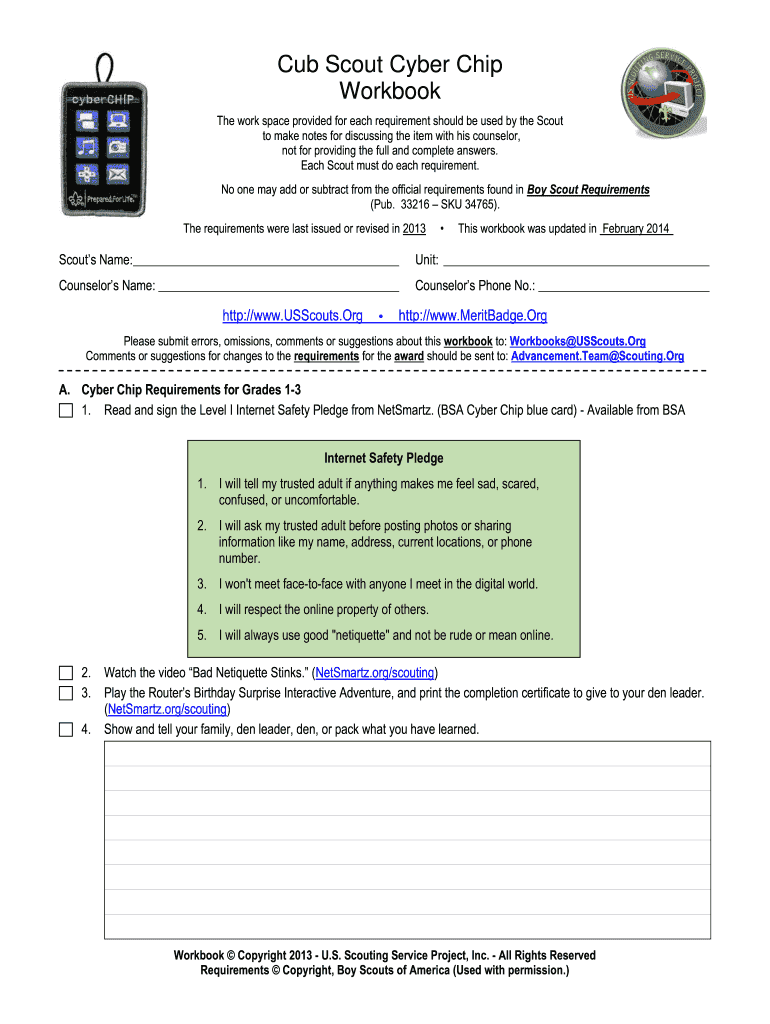
Cyber Chip Requirements by Grade Level
The Cyber Chip curriculum varies by age group to address evolving online risks and responsibilities.
Cyber ChipU.S. Scouting Service Project

Grades 6–8 (Scout Rank)
- Internet Safety Pledge: Sign the Level II pledge committing to respect others, protect personal information, avoid cyberbullying, and seek parental permission before meeting online acquaintances offline12.2. Personalized Device Contract: Collaborate with parents to outline rules for downloads, social media posts, and consequences for misuse. Example clauses include avoiding illegal downloads, protecting passwords, and reporting cyberbullying1.3. Educational Videos: Watch Friend or Fake and two additional Netsmartz videos (e.g., Cyberbullying or Gaming Safety) to recognize online risks1.4. EDGE Method Lesson: Teach internet safety to peers using the EDGE framework (Explain, Demonstrate, Guide, Enable). Topics include applying the Scout Law online, identifying scams, and proper “netiquette”17.5. Electronics Policy Discussion: Review troop guidelines for device usage during meetings and outings15.
Grades 9–12 (Star Rank)
Includes all requirements for grades 6–8, plus: 6. Social Media Analysis: Discuss with parents the dual-edged nature of platforms like Instagram or TikTok, covering benefits (networking, learning) and dangers (cyberbullying, scams, identity theft). Scouts must provide real-world examples14.
Key Components of the Cyber Chip Program
Internet Safety Pledge
The pledge emphasizes five principles:
- Think before posting.- Respect others and intellectual property.- Avoid in-person meetings with online contacts without parental consent.- Protect personal data15.
Device Contract Template
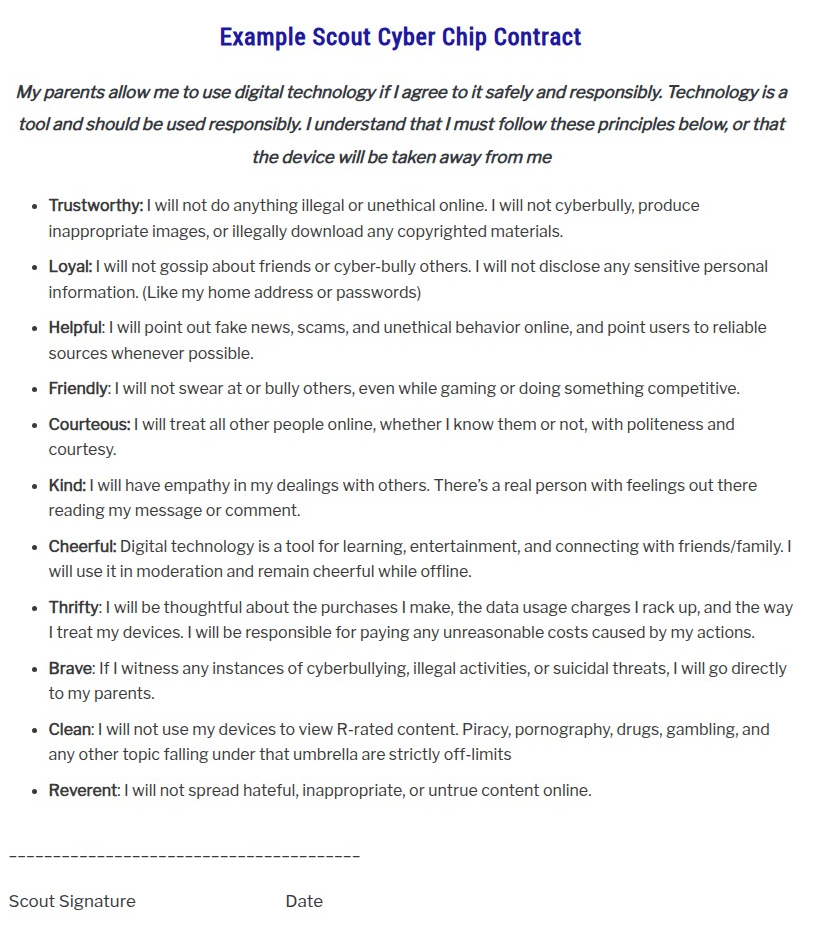
A sample contract aligns with the Scout Law:
- Trustworthy: No illegal downloads or cyberbullying.- Loyal: Protect passwords and avoid gossip.- Brave: Report harmful content to adults1. Scouts and parents sign the agreement, with violations leading to device restrictions15.
Teaching with the EDGE Method
Scouts lead lessons on topics like:
- Recognizing phishing scams.- Balancing screen time.- Avoiding oversharing on social media. Patrols divide roles to cover rules, behavior, and netiquette17.
Annual Renewal
Cyber Chips expire yearly. To “recharge,” Scouts must:
- Complete two new Netsmartz resources (e.g., videos or quizzes).2. Update their Cyber Chip card with a leader157.
Why the Cyber Chip Matters
- Safety: Addresses cyberbullying, predators, and scams through proactive education6.- Rank Advancement: Mandatory for Scout and Star ranks, as well as Digital Technology and Programming merit badges45.- Lifelong Skills: Teaches critical thinking about online content and digital footprint management16.
The BSA Cyber Chip prepares Scouts to harness technology responsibly while mitigating its risks. By blending structured learning with practical application, it fosters a generation of digitally savvy leaders who embody the Scout Oath both online and offline16. For resources like video links, contract templates, and Netsmartz access, visit ScoutSmarts1.
Scouts BSAScouting America are committed to creating safe environments for Scouts and leaders. Child abuse is an uncomfortable topic but an important one for us to cover to ensure the safety and well-being of our Scouts and leaders. Scouting America has partnered with subject-matter experts from the Barbara Sinatra Children’s Center Foundation to present the Personal […] Boy Scouts of America
 To be awarded your cyber chip, you’ll need to read, understand, and agree to the internet safety pledge below.* (This same pledge will also be printed on the back of your cyber chip award)*
- I will think before I post2. I will respect other people online3. I will respect digital media ownership4. I won’t meet face-to-face with anyone I meet in the digital world unless I have my parent’s permission5. I will protect myself online.
If you don’t have a cyber chip card on hand, I’d bet your Scoutmaster has a spare one for you to use!
How can Scouts effectively use the EDGE method to teach internet safety
Scouts can effectively teach internet safety using the BSA’s EDGE method—Explain, Demonstrate, Guide, Enable—by structuring lessons around hands-on learning, collaboration, and practical application. This approach ensures Scouts internalize safety principles while developing leadership skills. Below is a step-by-step breakdown of how to apply EDGE to internet safety education:
Applying the EDGE Method to Internet Safety
1. Explain: Clarify Key Concepts
Scouts begin by outlining core internet safety topics using age-appropriate materials:
- Rules: Review the BSA Cyber Chip pledge, emphasizing principles like protecting personal data, avoiding cyberbullying, and respecting intellectual property13.- Behavior: Discuss real-world dangers (e.g., phishing scams, oversharing on social media) and the importance of parental oversight28.- Netiquette: Highlight courteous online communication and the connection between the Scout Law and digital conduct26. Example: Use the Netsmartz Student Project Kit (grades 9–12) to frame discussions about social media risks and benefits26.
2. Demonstrate: Show Safe Practices
Scouts model safe behaviors through examples:
- Role-play scenarios like identifying phishing emails or responding to cyberbullying.- Screen-share a social media post to illustrate privacy settings and oversharing risks28.- Display the “Friend or Fake” video to teach spotting online impersonators18. Tip: Patrols can split roles—one Scout explains password security, another demonstrates reporting suspicious activity16.
3. Guide: Facilitate Hands-On Practice
Learners apply concepts with supervision:
- Activities:Create strong passwords and test their resilience.- Draft a “digital footprint audit” to assess past posts for oversharing.- Use the EDGE Teaching Kit to design a quiz on netiquette25. Feedback: Patrol leaders correct mistakes (e.g., unsafe app permissions) and reinforce best practices45.
4. Enable: Foster Independent Application
Scouts solidify skills through real-world tasks:
- Projects:Design a poster campaign on cyberbullying prevention for younger troops.- Update their Cyber Chip contract to include new apps or devices18.- Lead a troop discussion on balancing screen time during camping trips36. Renewal: Annual “recharging” involves reviewing updated safety resources and re-signing pledges12.
Best Practices for Effective Teaching
- Collaborative Roles: Assign each patrol member a specific topic (e.g., one covers scams, another addresses privacy settings) to ensure engagement16.- Interactive Tools: Incorporate videos, quizzes, and the Netsmartz Student Project Kit to cater to visual and auditory learners28.- Scout-Led Discussions: Relate internet safety to the Scout Oath and Law (e.g., “A Scout is trustworthy” = protecting passwords)24.
By integrating EDGE with real-world examples and patrol collaboration, Scouts transform theoretical knowledge into actionable habits, fostering a culture of digital responsibility within their troops.
Citations:
- https://scoutsmarts.com/cyber-chip/2. https://scoutsmarts.com/cyber-chip/3. https://blog.scoutingmagazine.org/2012/06/04/with-bsas-new-cyber-chip-online-safetys-the-point/4. https://blog.scoutingmagazine.org/2014/06/07/why-every-scout-or-venturer-needs-to-earn-the-cyber-chip/5. https://troop279.us/earning-your-cyber-chip/6. https://wnyscouting.doubleknot.com/cyber-chip-20/674857. https://troop2193.org/cyber-chip8. https://discussions.scouting.org/t/tracking-the-personal-safety-awareness-cyber-chip-replacement/4112269. https://www.longbeachbsa.org/training/youth-training/cyberchip/10. https://www.reddit.com/r/BSA/comments/1hfhqbj/the_guide_to_advancement_has_been_updated_for/11. https://www.newenglandbasecamp.org/wp-content/uploads/2020/03/The-Importance-of-BSA%E2%80%99s-Cyber-Chip.pdf12. https://www.americanfork.gov/DocumentCenter/View/5138/Boy-Scout-Cyber-Chip13. https://www.scouting.org/programs/scouts-bsa/advancement-and-awards/14. https://www.reddit.com/r/BSA/comments/vjupok/current_state_of_the_cyber_chip/15. http://usscouts.org/advance/cyberchip.asp16. https://troopleader.scouting.org/program-features/technology/information/17. https://www.scouter.com/topic/30900-be-prepared-to-teach-a-cyber-chip-class/18. https://www.glencoescouting.org/resources/cyber-chip/19. https://www.mccscouting.org/advancement20. https://discussions.scouting.org/t/scouts-bsa-advancement-updates-eff-1-1-24/40616521. https://scoutles.com/cyber-chip-guide/